

Human-guided AI is not just a tool; it's a continuous feedback loop. Discover the system that allows human expertise and automated systems to achieve more, faster.
Discover the CycleOver the past few weeks, after writing about the concept of Iterative Intelligence, a number of people have asked me a very simple, yet profound question: “What does that actually look like in practice?”
To truly grasp what is happening right now, we must fundamentally shift our perspective. The easiest way to understand this new paradigm is to stop thinking about AI as a discrete 'tool' and start thinking about it as an integral part of a continuous 'cycle'. For decades, our interaction with computers has been a linear, command-and-response process. That model is already starting to break. We are now moving into something very different: a continuous feedback loop between human expertise and automated systems.
I call this new model the Iterative Intelligence Cycle. While the phrase has appeared in discussions about AI over the past few years, my goal here isn’t to claim ownership of the term, but to explore how the idea can be applied practically in the way we design systems, organizations, and creative work. At its simplest, the cycle looks like this:
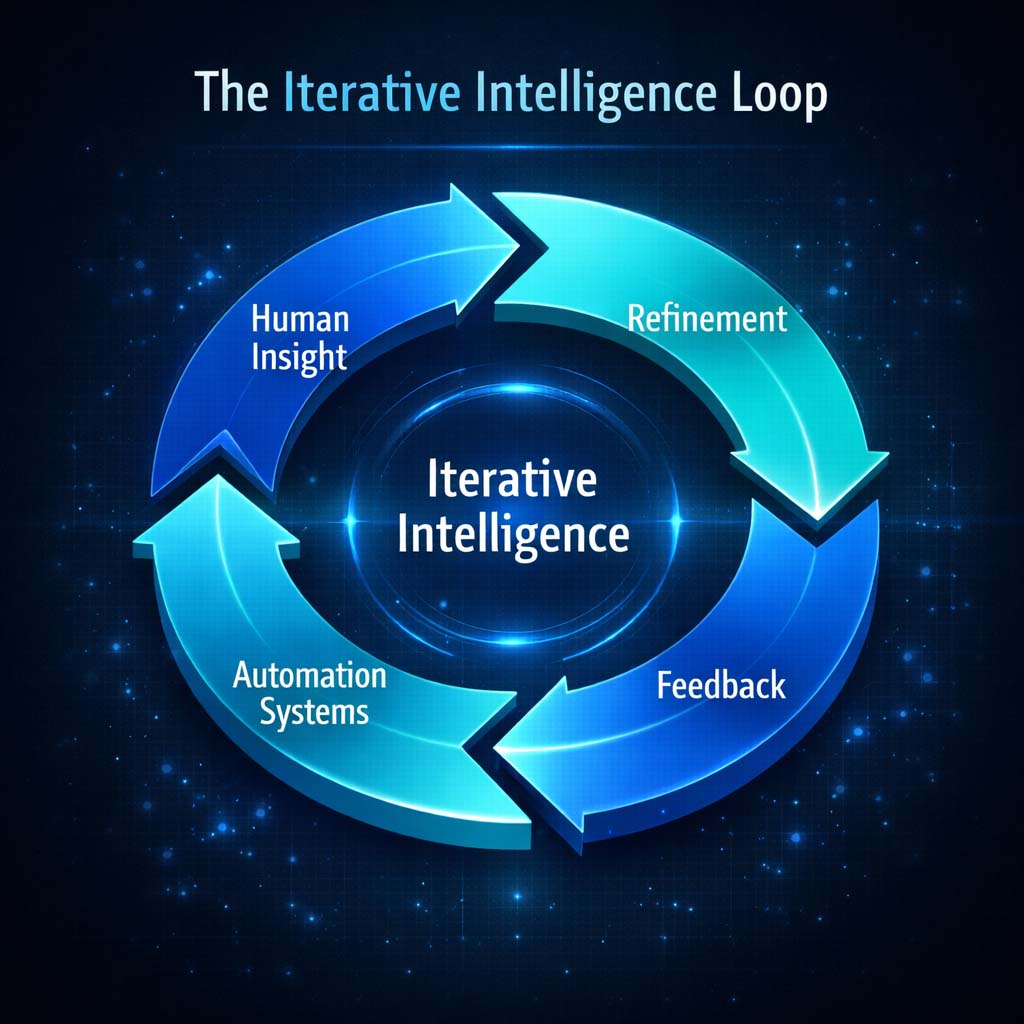
Each pass through this cycle improves the outcome. The machine becomes more useful, its outputs more aligned with the goal. The human becomes more effective, their expertise amplified by the machine's speed. And the speed of creation itself accelerates dramatically.
This is the critical insight: The intelligence isn’t in the machine. The intelligence emerges from the loop. It is the symbiotic relationship, the constant refinement, and the fusion of human judgment with machine execution that creates a result far greater than either could achieve alone.
I’ve experienced this personally and profoundly over the past few months while building new, complex systems from scratch. In the past, some of the work I’ve been doing recently would have required a dedicated team of developers, analysts, and designers working for months, with significant capital investment and risk.
Instead, the process now looks something like this:
Idea ↓ Design the architecture ↓ Work with automated systems to generate components ↓ Evaluate the results ↓ Adjust direction ↓ Generate again ↓ Improve ↓ Repeat
Each loop produces better, more refined results than the last. What used to take months of painstaking, linear development now happens in days or weeks. This isn't because the machines are replacing people. It's because they dramatically accelerate the iterative process, allowing for a rate of progress that was previously unimaginable.
When the cycle of iteration becomes nearly instant, the fundamental pace of innovation changes. Ideas that used to die on the whiteboard because they were too expensive or time-consuming to prototype can now be explored rapidly and cheaply. Entire systems can be designed, tested, and completely rebuilt multiple times in the same week. This compression of the creation timeline unlocks unprecedented potential for experimentation and discovery.
One of the biggest misconceptions about AI is that it devalues or replaces human expertise. In reality, the opposite is happening. The people who benefit most from iterative intelligence are those with deep domain experience. Why? Because they know what to ask for, what 'good' looks like, what problems actually matter, and what common mistakes to avoid. Without human judgment, automated systems produce noise. With experienced guidance, they produce incredible leverage.
This is where things become uncomfortable for established industries. Entire categories of work over the past fifty years have been built around slow, deliberate iteration cycles: research, development, analysis, content creation, software engineering. When iteration speeds up by an order of magnitude, the economic and organizational structure of those industries inevitably changes. The question is not whether this shift will happen. It already is. The real question is whether we learn to guide it wisely.
One thing has become very clear to me during this process: automation does not replace human intelligence. It amplifies it. The machines are not deciding what the future should look like; they are simply accelerating the process of building it. This means the most important skill in the next decade will not be coding, prompting, or automation expertise. It will be something much older and more fundamental.
The crucial skills will be:
The tools we are building right now are incredibly powerful, but their power comes from the way they interact with human thinking, not from replacing it.
We are entering an era where human creativity and automated systems work together in continuous, rapid cycles of improvement. An age where intelligence is not just artificial or human, but truly iterative.
This is not a distant future. It's the new reality for organizations and individuals who are willing to adapt their processes and embrace this powerful collaborative model. The potential is immense, and we are only at the very beginning of understanding what's possible.
Build Your Iterative System